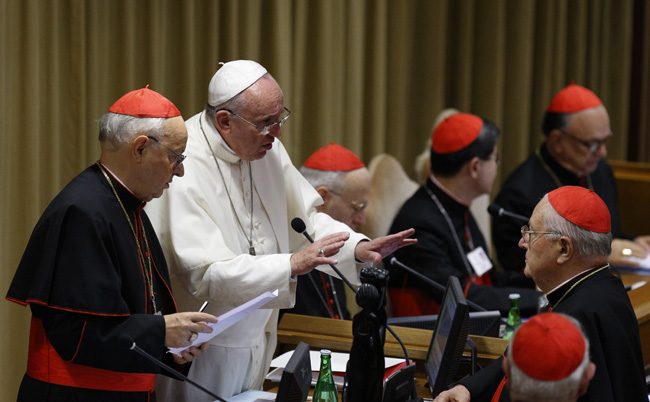
Once again, Pope Francis has gotten people talking excitedly about changes in the Catholic Church by saying basically the same things his predecessors have said. If there’s anything positive about the “progressive pope” narrative frame, it gets the media to pick up on things that they ignored when Benedict XVI and St. John Paul II said them.
What did Pope Francis say this time? Yesterday, August 5,
in his general audience, he chose to address the situation of divorced and remarried Catholics. Fairly early into his catechesis, Francis said:
In these decades, in truth, the Church has not been either insensitive or slow. Thanks to the reflection carried out by Pastors, guided and confirmed by my Predecessors, the awareness has greatly grown that a fraternal and attentive acceptance is necessary, in love and in truth, of the baptized that have established a new coexistence after the failure of their sacramental marriage; in fact, these people are not at all excommunicated, they are not excommunicated! And they are absolutely not treated as such: they are always part of the Church. [Bold type mine.—ASL]
Excommunication refers strictly to the formal canonical penalty. Under
Canon 1331.1 of the 1983 Code, a person who has been formally excommunicated cannot minister in any capacity in any manner of worship, celebrate or receive the sacraments, or exercise any official office or function of the Church. In some cases, excommunication is incurred
latae sententiae; that is, by the fact of the delict and without need of formal declaration (
Canon 1314). However, marrying a second person without securing an annulment of marriage from the first is not one of those cases. And
excommunication does not deprive one of membership in the Catholic Church; even if you formally apostatize, rejoining is simpler than you’d think.