Showing posts with label Ask Tony. Show all posts

Sunday, November 6, 2016

Ask Tony: Is It a Sin to Vote Democrat?

Image source: KFMB CBS8 San Diego.
Doubtless, you’ve heard of the San Diego Catholic church where a flyer inserted in the weekly bulletin asserted that it’s a mortal sin to vote Democrat. The flyer was a cut-and-paste job, reprinting material from Catholic Answers’ “Voters Guide for Serious Catholics”,[1] adding a chart comparing CA’s list of “non-negotiables” to the Democrat and Republican Parties’ platforms. On top of that, the church’s pastor wrote an article which goes beyond to name ten different forms of “enslavement” which “have come from our elected officials, appointed judges, and Catholics who have voted for them and supported them.”

Bp. McElroy Responds

Immaculate Conception’s pastor, Fr. Richard Perozich, claimed, “the flyer was written by an outside group, wasn’t reviewed by him and ‘went a little beyond’ the approved message.” “I would never tell anyone to ‘vote this’ or ‘vote that,” Fr. Perozich said. However, Keith Michael Estrada of Proper Nomenclature notes, “a review of bulletins published online shows that the parish has been sharing questionable material, at odds with the guidance of the US Bishops — even criticizing [San Diego] Bishop [Robert] McElroy on at least one occasion — for quite some time.”

The San Diego chancery finally responded on Friday with a statement by Bp. McElroy, in which His Excellency stated firmly that Immaculate Conception had violated a duty to “participate in discussions about the election with civility and balance.” He continues, “… [Thus] it is essential to make clear: 

  • “It is contrary to Catholic teaching to state that voting for a Democrat or Republican automatically condemns the voter to hell;
  • “It is contrary to Catholic faith to state that gun control legislation is a form of slavery;
  • “It is contrary to Catholic faith to fan the flames of hatred against Muslims or any religious group.”


Thursday, October 20, 2016

Ask Tony: Is Voting Third-Party or Write-In a “Sin of Omission”?

This is how political ideology distorts religion.
As the 2016 U.S. presidential campaign staggers toward its finale, Catholic supporters of Donald Trump are going all out to push pro-life voters to cast their ballots for the Republican nominee. Some are even going so far as to engage in what can only be called doctrinal strong-arm tactics. Because Hillary Rodham Clinton is pro-abortion, a strong supporter of Planned Parenthood, and has a restrictive view of religious rights, it’s taken as granted that a vote for her is tantamount to approving her policy choices on these fronts, and therefore formal cooperation in evil.[*] However, the reasoning is extended: by failing to vote for Donald Trump, a third-party/write-in voter is wasting their vote, and therefore committing a sin of omission.

Defining Our Terms

First, let’s define our terms. But before we do, let me remind you: Infallibility applies to the Catholic Church only on matters of faith and morals, and only under specific conditions. Individual Catholics, especially lay bloggers, are not infallible. With that caveat:

In Catholic moral theology, sins can be divided into four categories: sins of thought, sins of word, sins of commission, and sins of omission. A sin of omission, according to The Catholic Encyclopedia, is “the failure to do something one can and ought to do. If this happens advertently and freely a sin is committed. Moralists took pains formerly to show that the inaction implied in an omission was quite compatible with a breach of the moral law, for it is not merely because a person here and now does nothing that he offends, but because he neglects to act under circumstances in which he can and ought to act.”

Sins are also classified according to whether they are venial or mortal. “Mortal sin destroys charity in the heart of man by a grave violation of God's law; it turns man away from God, who is his ultimate end and his beatitude, by preferring an inferior good to him. Venial sin allows charity to subsist, even though it offends and wounds it” (Catechism of the Catholic Church § 1855). A mortal sin is committed when the object is grave matter (i.e., a violation of the Decalogue), and when it is committed with full knowledge and deliberate consent (cf. CCC § 1857; see link above).

Material and formal cooperation pertain to the degree that an accomplice actually participates in the sin of the principal agent. Says The Catholic Encyclopedia, “For example, to persuade another to absent himself without reason from Mass on Sunday would be an instance of formal cooperation. To sell a person in an ordinary business transaction a revolver which he presently uses to kill himself is a case of material cooperation.” Formal cooperation pertains, then, when the person assists a person in an evil act freely and in full knowledge of its wrongness. With material cooperation, “the action of the accomplice is assumed to be unexceptionable, his intention is already bespoken to be proper, and he cannot be burdened with the sin of the principal agent since there is supposed to be a commensurately weighty reason for not preventing it.” There is also a distinction between proximate and remote cooperation.

Tuesday, August 23, 2016

Ask Tony: Forgiveness and Sincerity—UPDATED

Hypothetical situation: A friend, loved one, coworker, or acquaintance has a certain behavioral trait, one that is objectively sinful and hurtful. At times, you are the one s/he hurts. Every time s/he hurts you, s/he apologizes. After n apologies and n +1 times being hurt, though, don’t you have a right to feel his/her apologies are insincere? Shouldn’t the behavior have been corrected by then if s/he really meant it? In sum, aren’t you justified in refusing to forgive, or making your forgiveness contingent upon some material act?

Seventy Times Seven

There are only two passages in the New Testament where a finite number is connected with forgiveness. The first occurs in Matthew 18:21-22:

Then Peter came up and said to him, “Lord, how often shall my brother sin against me, and I forgive him? As many as seven times?” Jesus said to him, “I do not say to you seven times, but seventy times seven.”

Jesus then follows this injunction with the parable of the Unforgiving Servant (vv. 23-35). The “seventy times seven”, of course, is hyperbole meaning that we forgive as often as asked: “... and if [your brother] sins against you seven times in the day, and turns to you seven times, and says, ‘I repent,’ you must forgive him” (Luke 17:4). However, you don’t have to wait to be asked forgiveness in order to grant it.

As for sincerity — nope. Don’t find it connected to forgiveness of others anywhere in the NT. It’s not a condition. Nor do you find any passage that allows you to make forgiveness conditional. Catholics have done penitential acts over the centuries. However, those acts were reparative; that is, they were ordered towards repairing the relationship between the person and God, and not as a condition of His forgiveness. Making your forgiveness contingent upon fulfilling a material condition as “proof” of sincerity is spiritual extortion.

Tuesday, June 14, 2016

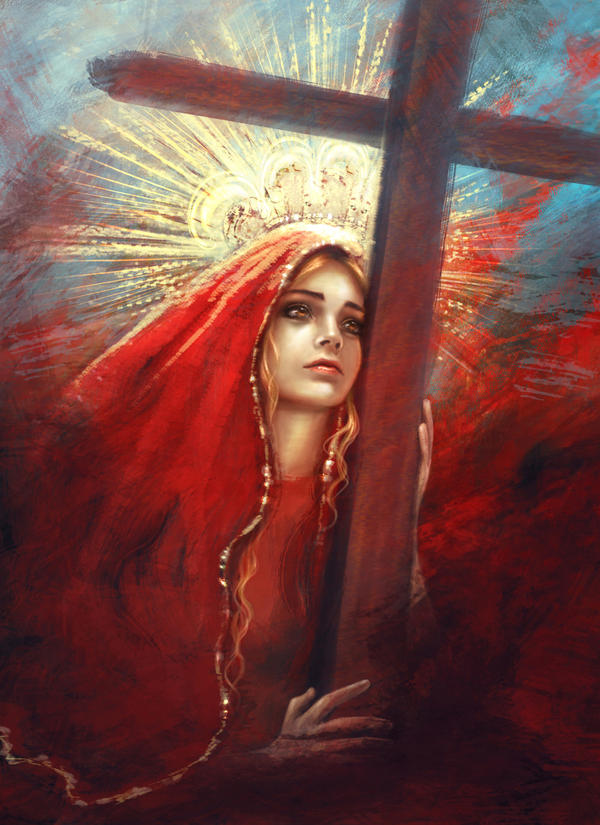
Ask Tony: A feast for Mary Magdalene?

Blavatskaya, Mary Magdalene.
(Image source DeviantArt.net)
On June 10, the Congregation for Divine Worship released a document raising the liturgical observance of St. Mary Magdalene’s traditional day from a memorial to a feast. Released along with it is an accompanying letter, Apostle to the Apostles, over the signature of the secretary of the congregation, Abp. Arthur Roche. Now would be a good time to explain who she is in the Catholic tradition, and why the Holy See has taken such an extraordinary step.

Who was Mary Magdalene?

“Mary” (Heb. Miriam, Aram. Maryam, Gr./L. Maria) was a common name among the Judeans, and due to the influence of both the Blessed Mother and the Magdalene would be common in Christian lands for the next twenty centuries. (Maryam is also frequent among Moslems, among whom the Blessed Virgin Mother is honored.) So in the New Testament there is a surfeit of women named Mary, not always kept distinct from each other.

There are two locations named “Magdala” in Talmud: one in the east on the River Yarmouk near the modern town of Umm Qais, the other on the western shore of the Sea of Galilee, abandoned just prior to the 1948 Arab-Israeli war, near the town of Migdal. Given the number of Galileans among Jesus’ disciples, Mary most likely came from the latter.

We know very little about Mary’s story. According to Luke, Mary joined Jesus’ ministry early. He tells us that “seven demons had gone out from” her, indirectly attributing it to Jesus, and that she was one of several women who accompanied Jesus and the apostles, “[providing] for them out of their means” (Luke 2:1-3) After the Easter narratives, Mary of Magdala drops out of the scriptural record.

Wednesday, September 30, 2015

Ask Tony: What does the Catholic Church teach about sex changes?

Caitlyn Jenner, the face of transgenderism.
A couple of weeks ago, in Outside the Asylum, I addressed Pope Francis’ recent letter on the Holy Year of Mercy. Today, I received a question there from Charles: “I know a man who recently decided to undergo a sex change procedure. What is the Church’s position on this?”

A Not-So-Obvious Answer

This question comes at a sensitive time for my family and me, as one of my cousins is “transitioning” from a male to a female identity. The answer would seem to be obvious to many people; the best course of action, then, is to research the question to make sure the obvious answer isn’t wrong.

Surprisingly, the answer doesn’t lie in one single Vatican-issued document such as the Catechism of the Catholic Church or a papal encyclical like Deus Caritas Est. According to the Catholic News Service, in 2000 the Congregation for the Doctrine of the Faith did issue a sub secretum letter to the various papal legates, and again in 2002 to the presidents of bishops’ conferences. Strangely enough for a secret document, this letter has remained secret — unlisted with other CDF letters and ad dubitum documents, unmentioned in the USCCB website, and not readily available through Google or Bing. (Apparently Wikileaks hasn’t gotten around to it yet.)

Nevertheless, various Catholic people and sources have addressed the questions of sexual identity and gender reassignment surgery. In lieu of any formal definitive statement, I can attempt an informed provisional answer. And it turns out the answer isn’t as obvious as you may think.

Friday, March 20, 2015

Ask Tony: Am I really Catholic if I can't accept some Church teachings?

Lisa Miller tried to answer this question last September in her "OMG!" column in Crux. Just based on this one column, I can't say anything about Miller's orthodoxy. But considering that Crux also published Margery Eagen's doctrinally-illiterate rant against Pope Francis this last January, I'm beginning to wonder whether the Crux editors are merely indiscriminate in their writer selections or actively dissident in their  ecclesial adherence.

[UPDATE: Crux just published an op-ed by John L. Allen, Jr., in which the latter continually refers to the schismatic Society of St. Pius X (SSPX) as though they were representative of traditionalists. This pretty much confirms Crux's leftward bias, though I'm disappointed in Allen, who ought to know better. (But then, didn't he coin the term "Taliban Catholic"?)]

Miller never really answers the question as asked. At first, it looks like she's on the side of the angels, when she admits that "'conscience' is the tool people use to justify departures from orthodoxy." As I've argued elsewhere, the individual conscience isn't infallible. But she quickly varies from the straight and narrow:

There are women who, in good conscience [??], have taken priestly ordination vows and consider themselves Catholic; and (many more) people who’ve had abortions or supported the right to abortion who do as well. These self-defined Catholics defy official teaching and risk excommunication [in the case of a procured abortion, the excommunication is latae sententiae, i.e., automatically incurred by the offense (CIC 1398)]; yet on some level, the choice to be Catholic remains a deeply personal (and private) one.

Which is all simply a warm-up to her own thesis: "To what extent must the hierarchy heed the consciences of the faithful? ... My unordained advice ... is this:  Hold onto your Catholicism — as well as your conscience — and perhaps your leaders will follow you there." Miller's answer, underneath all the window dressing, is: "You're Catholic if you think you are."

It's bad advice, and a bad definition. If you don't believe what the Church believes, then why would you think you're Catholic? If the Church doesn't teach authoritatively on matters of faith and morals, then why do you need the hierarchy's blessing for anything? Why not just go to some church where they already agree with you?

But if the Church does teach authoritatively, then why don't you try to change?

Monday, March 9, 2015

Ask Tony: Is opposition to capital punishment “heresy”?

There are some people who can’t be satisfied with just being right — they have to spoil it by going that extra yard, so they’re not only not as right as they could have been, they’re also a bit meshuggeh to boot. It’s almost like watching a player on the defense grab a fumble and down it ... in his own end zone.

Recently, four major Catholic media sources — well, three Catholic and one that insist it’s Catholic — published a joint editorial calling for the end of capital punishment: America magazine, the National Catholic Register, Our Sunday Visitor, and the National Catholic Fishwr — er, Reporter. Naturally, this announcement caught the Catholic Blogisterium by not-universally-pleasant surprise. 

One of the least pleased was Br. Alexis Bugnolo of the blog From Rome, who lashed back with a post titled, “It is a heresy to say Capital Punishment is immoral, or can be abolished”. No, really ... that is the title, and that is his argument:

Rome, March 6, 2015:  The agenda of  Communism* to disarm Christendom more and more has reached fever pitch this week with pronouncements by the Vatican Observer at the United Nations, the Pope, and several media outlets in the United States against the death penalty. [* Marx held that the way to social justice was through class revolution, and that capital punishment was the tool of the rulers to suppress the masses: this error promoted through liberation theology has spread from Europe to most of Latin America. (So how does this make the various calls to end capital punishment “communist”? Damned if I know.)] ...
Patheos a left-wing, [?] source for news and opinion for Catholics in the English speaking world, is running a story today about this, entitled, “Catholic Media Unite in Opposition to the Death Penalty”. [Specifically, the post Br. Bugnolo linked was in Kathy Schiffer’s Seasons of Grace. Whatever else Kathy may be, besides a very pleasant writer to read, she’s no leftist. Neither are Fr. Dwight Longenecker, Kat Fernandez, Elizabeth Scalia, nor Mark Shea; but then, anybody not as far to the right as Br. Bugnolo must appear to be a leftist.] ...
The title of their article is more than misleading, it is implicitly heretical.° [° Inasmuch as it says that such pronouncements are Catholic. (Inasmuch as the title makes no such claim, the charge is explicitly hysterical; the word Catholic modifies Media, nothing else.)] For this simple reason, that it is de fide, that is a truth of Divine Revelation itself, that the State has the authority to punish wicked doers with capital punishment.

Heresy is “the obstinate denial or obstinate doubt after the reception of baptism of some truth which is to be believed by divine and Catholic faith” (Code of Canon Law 751; cf. CCC 2087 – 2089). Catholics who oppose the death penalty don’t deny that Church teaching permits or tolerates the death penalty. To justify his calling anti-death penalty writings heresy, then, it isn’t sufficient for Br. Alexis merely to argue that Church doctrine tolerates the death penalty; he must show that Catholic teaching mandates the death penalty as a moral duty of the State.

Friday, March 6, 2015

Ask Tony: What if a priest were to bless the entire ocean?

Blessing of the Sea, Whitstable.
(© 2010 Matt S., via Flickr.com)
So there's this question making the rounds that, on first glance, simply confuses Catholic priests with clerics from Advanced Dungeons & Dragons™:

what if a catholic priest were to just bless the entire ocean would it turn the entire thing into holy water or do priests have an effective blessing range? does that range increase based on your level? can the pope bless the entire ocean?

The obvious first response is to ask in return, "Why would any priest want to turn the whole ocean into holy water?" Holy water is confected (the proper term) for specific liturgical purposes; none has yet been found or even thought of that would require every drop in every ocean be consecrated. Priests, generally speaking, don't perform sacred rituals just to satisfy curiosity or scratch an itch. The obvious second response is, "How would the blessing of a Catholic priest differ from that of an Orthodox, or Anglican, or Lutheran priest?" Catholic priests are not the only ones who bless water; so why the question is asked specifically of Catholic priests is itself a question worth pondering ... just not one I'm going to ponder now.

Having cleared that crap out of the way ....

First, let's discuss what holy water is, and what it is not. Holy water is called a sacramental, that is, a sacred sign "by which effects, especially spiritual effects, are signified in some imitation of the sacraments and are obtained through the intercession of the Church." (Code of Canon Law 1166) Sacramentals, generally speaking, weren't instituted by Christ but rather by the Church, in aid of carrying out its mission. (Cf. Ludwig Ott, Fundamentals of Catholic Dogma, p. 349) While the ritual of blessing may create an ontological change in the water, giving it spiritual influence, the liturgical point is to reserve the water for sacred purposes; holy water isn't supposed to be used for cooking, or washing your dirty clothes, or as a substitute for your hypertension medication.


Saturday, January 3, 2015

Ask Tony: What's the Catholic Church's position on "enhanced interrogation techniques"?—UPDATED

Source: Washington Post.
A: "Enhanced interrogation technique" is simply a euphemism for torture. The Church teaches that torture is intrinsically evil.

It's really not rocket science. As the Catechism of the Catholic Church says, cruel practices, even when used to maintain law and order by legitimate governments, are not "in conformity with the legitimate rights of the human person". (CCC 2297-8) In a speech in Sept. 2007, Benedict XVI stated unequivocally, "In this regard, I reiterate that the prohibition against torture 'cannot be contravened under any circumstances' (Compendium of the Social Doctrine of the Church, 404)." Nobody should expect Pope Francis to support it, either.

In Romans 3:8, St. Paul specifically denies that the apostles teach a consequentialist message. This rejection is restated in Catechism § 1789: "One may never do evil so that good may result from it" is a rule "that applies in every case".

One of the many things St. John Paul II apologized for in the name of the Church was the sanction of torture in securing confessions to heresy. It really doesn't matter, for our purposes, that its use was hedged about with many restrictions, that the clergy never directly participated, or that it was a matter of discipline rather than dogma (and so is covered by neither infallibility nor "tradition").The Church was wrong to do so, and there's an end to it.

Then why, you may ask, did so many white Catholics (the only Catholics represented) come out in favor of torturing suspected terrorists on the recent ABC/Washington Post poll?

Stan Goff, the author of Chasin' Jesus, suspects that part of the answer is due to relentless indoctrination by Hollywood:

... [T]he whole subject is embedded in carefully formulated, dramatic hypotheses. Moreover, we are all indoctrinated with ... "electronic hallucinations" nearly from birth that implant these hypothetical situations in our heads. Television and film, to be more precise, the most effective tools for mass indoctrination in the history of the world, have bombarded us with concocted stories that revolve around something that the late Russian film theorist Sergei Eisenstein labeled the "tempo task." ...

Any time we have this debate, those who want to justify torture evade discussion of the actual acts of torture (breaking someone's limbs with iron bars, for example, or letting him be chewed up by attack dogs, or pumping pureed hummus up his ass, or plunging him into ice water until his core temperature drops), and instead deploy a tempo task scenario. What if he has armed a nuclear bomb in Times Square and you have ten minutes to find it and disarm it? The purpose of the tempo task scenario is not to establish some moral line, but to dispense with morality altogether in favor of pragmatism in extremis.


Friday, December 26, 2014

Ask Tony: What did Jesus mean by "fulfilling" the Law of Moses?

Last year, I created the meme to your left to counter another meme based on a rant by John Fugelsang (isn't it indicative of how screwed-up our culture has become that people would make an actor/comedian an authority on religion?).

Fugelsang argued that Jesus wasn't anti-gay, based on the fact that the Gospels don't record anything from him on homosexual relations. However, as I've argued on The Other Blog, if Jesus had said anything supporting gay relationships or controverting Leviticus 18:22, "you can be morally certain the disciples and apostles would have made much of such a counter-cultural affirmation. Jesus' silence, in view of what was taught both before and after his mission, must be construed as consent to the Law: Qui tacet consentire videtur" [loosely, "Silence must be seen as consent"].

However, in creating the counter-meme, by reminding that Jesus "did not come to abolish the law ... but to fulfill [it]" (Matthew 5:17), I stepped into some quicksand. And a non-Christian caught me on it:

[Jesus'] "silence" on abortion and homosexuality could be seen as his "going along" with previous Jewish law, but doesn't that leave you with the problem of all the other kinda awkward Jewish laws ... like about eating pork or not touching menstruating women? (Please address this — I'd love to know why homosexuality is different in this regard.)

 I hate to admit it, but I got sloppy. The fact is, Jesus' fulfillment of the Law of Moses did free us of the Law. What Jesus' fulfillment of the Law didn't do, however, was free us of the spiritual need for moral behavior, or make the concept of sin irrelevant.

Thursday, December 11, 2014

Ask Tony: Did Pope Francis just teach that animals go to heaven? — UPDATED

The short answer: No. The Pope didn't say anything like that; the Pope didn't say anything remotely near that.

This is possibly the most bizarre case of papal malreportage I've seen since I started writing. Somehow, Pope Francis' simple reassertion of orthodox teaching about the future renewal of creation got transmogrified into a declaration that animals go to heaven.

Let's begin with the papal general audience of November 26, as reported by Zenit. The general audience has often been an opportunity for the reigning pontiff to catechize the people directly, as well as to make remarks on current events or give a report on what he's been doing the last week.

Francis began the homily, "In presenting the Church to the men of our time, Vatican Council II was very conscious of a fundamental truth, which must never be forgotten: the Church is not a static, still reality, an end in herself, but is continually journeying in history towards the ultimate and wonderful end which is the Kingdom of Heaven, of which the Church on earth is the seed and the beginning. ... And some questions arise spontaneously in us: when will this final passage happen? What will the new dimension be like, which the Church will enter? What, then, will happen to humanity and to the creation that surrounds it?"

The end towards which the Church journeys, "Paradise", is "[m]ore than a place, it is ... a 'state' of mind in which our most profound expectations will be fulfilled overabundantly and our being, as creatures and children of God, will reach full maturity," said the Pope. "We will finally be clothed with joy, with peace and with the love of God in a complete way, no longer with any limit, and we will be face to face with Him! It is beautiful to think this, to think of Heaven. All of us find ourselves down here, all of us. It is beautiful; it gives strength to the soul."

So far, so good. Then:
At the same time, Sacred Scripture teaches us that the fulfilment of this wonderful plan cannot but be of interest also to all that surrounds us and that issued from the thought and heart of God. The Apostle Paul affirms it explicitly, when he says that "creation itself will be set free from its bondage to decay and obtain the glorious liberty of the children of God" (Romans 8:21). Other texts use the image of a "new heaven" and a "new earth" (cf. 2 Peter 3:13; Revelation 21:1), in the sense that the whole universe will be renewed and will be freed once and for all from every trace of evil and from death itself. What is anticipated, as fulfilment of a transformation that in reality is already in act since the Death and Resurrection of Christ, is, therefore, a new creation; not, therefore, an annihilation of the cosmos and of all that surrounds us, but a bringing of everything to its fullness of being, of truth and of beauty. This is the plan that God, Father, Son and Holy Spirit has always willed to realize and is realizing. [Bold and italic fonts mine.—ASL]

Wednesday, October 15, 2014

Ask Tony: What's the big deal about the Synod on the Family?

Answer: There is no clear objective answer; so much depends on one’s ideological or ecclesial perspective.

First of all, let’s discuss what a synod is. Synod is a general word for an ecclesial gathering, and can range in size from a few local priests to as many bishops from around the world as can fit in St. Peter’s. Synod and council, according to the old Catholic Encyclopedia, are synonymous terms. Only when the bishops of the world are gathered under the presidency of the pope is it deemed an ecumenical or general council capable of legislating for the entire Church.

If we leave our description here, it would seem that this Synod is simply a “talk shop”, a manufactured event in which the participants can discuss change without actually changing anything ... much like a session of Congress. It’s not quite that simple or cynical an exercise.

We in the West — especially in America — tend to assume that our concerns are shared by the whole world, or at least that they ought to be, and that the only people who matter are the people who think just like we do. This isn’t the case; what may sound like a splendid idea among American or German Catholics may not fly with Catholics in Estonia, or Burkina Faso, or South Korea.

For as much as has been made of Francis being the first pope from a Third World country, culturally he is in many respects as much a European as were his predecessors. Cardinal Walter Kasper, who has been carrying the standard for divorced and remarried Catholics, is a German of the Germans. The synod allows the pope and Cdl. Kasper to float trial balloons in an arena where the response is more international, and isn’t shaped by the Western media.

Sunday, July 13, 2014

Ask Tony: Can non-Catholics be saved?

A reader wrote the following question to my fellow Catholic Stand writer, screenwriter John Darrouzet:

I am confused on the Catholic stand on salvation. Some Catholic weblogs say a non-Catholic can not be saved unless they are ignorant of the Catholic church and are sincerely seeking God. Other blogs say the church never believed that non-Catholics cannot be saved. Help — what is the Catholic stand on salvation?

FAIR WARNING BEFORE I GO FURTHER: THIS POST IS MEANT TO ADDRESS THE CATHOLIC POSITION ON SALVATION. ANY TROLLS WHO WISH TO ASSERT THAT CATHOLICS THEMSELVES CAN'T BE SAVED WILL BE DELETED!  THIS IS MY LIVING ROOM; PLEASE RESPECT YOUR HOST!

Now that that's out of the way ....

If you read the question right, you'll see that the two sets of blogs actually say close to the same thing. While one emphasizes the negative, the other accentuates the positive (and don't blame me for the Bing Crosby earworm). Yes, non-Catholics can be saved, and the Church has always taught so; yet she has also taught, extra Ecclesia nulla salus (outside the Church none are saved). This would seem to be a contradiction on the face of it. The resolution is that the Church is the ordinary means of salvation, while the saving of non-Catholics is an extraordinary action on God's part not to be presumed upon.


Sunday, July 6, 2014

Ask Tony: Can you address a bishop as "Father"?

Writes a very dear friend of mine:

I have a regularly scheduling in-home massage client who is a "prominent" Catholic priest. When his secretary originally set up his appointments with me, she referred to him as Father , so that is how I've always addressed him. As we've gone along, we've had a few casual conversations. Within those conversations, I've addressed him as simply "Father", without the last name attached. He didn't seem offended at the familiarity. At my last visit, in one of these casual conversations, he discovered that, while I have a deeply rooted relationship with God, I am not Catholic. He seemed very surprised, almost shocked. I know that in his position he works with many people who are non-Catholics. I wondered what would cause this reaction. I thought that perhaps it is improper for me to address him in such a casual way or to refer to him as "Father". My intent was to reference his position and authority by addressing him as his title (as in "Mr. President", "Governor", "Doctor", etc). I don't want to offend him (if indeed I did). If it is improper for me to address him that way, what would be the better thing for me to use?

My answer: If you were introduced to him as "Father", then by all means address him as "Father" unless he himself objects to it. I take it by her comment that he "didn't seem offended at the familiarity" that he's probably a little higher up the ecclesial food chain — perhaps a monsignor? or the archbishop? Doesn't matter; the American hierarchy tends to be a pretty casual bunch. One blogger told me that, at one conference or another, he snuck outside for a cigarette and found himself in conversation with a cardinal who was also getting his nicotine fix. (As an "out" group, we smokers have a kind of instant cameraderie.) 

At any rate, calling him "Father" is more respectful than calling him by his first name alone, or calling him "Mister So-and-so". I know that there is some social pressure to get immediately chummy with every one we meet by calling them by their first name, even by their nickname. In fact, I usually know when someone has called me that I don't want to talk to — a salesman, a bill collector, a political pollster — because they inevitably call me "Anthony". And in my various inbound customer-service roles, my bosses have insisted we address customers by their first names even though I know from personal experience that it can be a customer irritant. So when a customer snaps back, "You don't know me well enough to call me '______'," I can relate all too well.

Monday, September 16, 2013

Ask Tony: Did the Pope just teach that atheists can go to heaven?—UPDATED

The short answer is "No". Not "not really"; not "not in so many words". Just "no".

In just a few months, a pattern has been set such that the ineffable Fr. John Zuhlsdorf could start a companion blog named "What Did the Pope Really Say?" and not run out of material for awhile. It seems that now a month can't go by without Papa Bergoglio saying something the Vatican has to explain or walk back. The mainstream press has cast the "progressive pope" filter in concrete, and will continue to run his impromptu remarks through it until he dies or relinquishes the Chair of Peter.

It doesn't help that Papa's words sometimes take three or four readings to get clear ... especially if you have to rely on Zenit's English translation, which is only marginally better than Babelfish. When he was elected, Marcelo González of Panorama Católico Internacional sneered, "Famous for his inconsistency (at times, for the unintelligibility of his addresses and homilies), accustomed to the use of coarse, demagogical, and ambiguous expressions, it cannot be said that his magisterium is heterodox, but rather non-existent for how confusing it is." His unique, populist style sometimes gets in the way of his clarity of expression.

Maybe he should get his new head of the CDF, Abp. Gerhard Müller, to proofread these things. Or, there's supposed to be a rather eminent and well-respected theology professor living in retirement at the Vatican ....

Let's start with the context. Eugenio Scalfari, editor of La Repubblica and a non-believer, published three questions for the Pope, to which Francis responded in an open letter. After setting some initial ground work, Francis wrote:

It seems to me that, in the first two, what is in your heart is to understand the attitude of the Church to those who don’t share faith in Jesus. First of all, you ask me if the God of Christians forgives one who doesn’t believe and doesn’t seek the faith. Premise that — and it’s the fundamental thing — the mercy of God has no limits if one turns to him with a sincere and contrite heart; the question for one who doesn’t believe in God lies in obeying one’s conscience [bold font mine.—TL]. Sin, also for those who don’t have faith, exists when one goes against one’s conscience. To listen to and to obey it means, in fact, to decide in face of what is perceived as good or evil. And on this decision pivots the goodness or malice of our action.

The context here is not about atheism specifically, but rather about non-Christians in general. In fact, the question is closely tied with another Scalfari asked about Jews. Moreover, the question was about forgiveness, not heaven, though the two concepts are tied together. However, these distinctions were lost on the press, who proceeded to announce that Pope Francis had opened heaven to atheists, causing orthodox facepalming and Evangelical howling (as exemplified by the noted prophet and theologian Kirk Cameron, who got it wrong, too).

Monday, March 25, 2013

Ask Tony: Why doesn't the Catholic Church give away its wealth?—UPDATED

Manipulative image-mashing, meet scriptural cherry-picking.
I'm sure that this question is coming up more frequently with the election of Pope Francis, who seems determined to continue to live according to his vow of poverty as much as is practical. 

 If you've been to Vatican City, and walked through St. Peter's, the Sistine Chapel and the Vatican Museum, your mind just boggles at the treasure of artwork contained there. Then again, you could go to any cathedral and see the bishop perform the Eucharistic Rite with gold or silver chalice and paten.

The Catholic Church is wealthy, you think. But that doesn't seem right; it doesn't seem to be in keeping with the Founder who had no place to lay his head (Mt 8:20; Lk 9:58). So why doesn't the Church give it all away?

The answer isn't as simple as some people would like you to believe.

The words "rich" and "poor" are properly used only of people, not of businesses or institutions. There are a lot of people who really don't understand business finance or how it differs from personal finance; you really need to take at least an Intro to Accounting course to appreciate it. They hear a bank has $2 billion in assets and don't really realize that that same bank may have $1.8 billion in liabilities, that some of those assets will consist of buildings, equipment and other physical items that can't be easily or quickly converted to liquid funds. All they know is that $2 billion is a lot of money. But asset is not just another word for cash or money.

The same problem obtains for the Church. You don't run homeless shelters and soup kitchens out of tents and RVs; house basements are rather impractical church spaces for all but the smallest congregations. Eventually you're gonna build churches for your congregations and offices for your charitable work and diocesan organization, and all these things must appear as entries in the accounting books. In personal finance, that may be wealth; for a non-profit organization, these are costs of doing business.

Tuesday, January 1, 2013

Ask Tony: Why would Catholics celebrate Jesus' circumcision?

Giovanni Bellini (1430-1516), Circumcision of Jesus
Today, January 1, is the Solemnity of Mary, the Mother of God, a holy day of obligation in the Catholic Church.  But on older calendars, since it falls on the eighth day of Jesus' life (according to traditional Jewish and Roman reckoning), it was — and still is, by traditional and Eastern Catholics, as well as some Lutherans — celebrated as the Feast of the Circumcision.

Now, if you focus on the fact of the circumcision itself, you can get kinda creeped out; just to add to the creepiness, the story goes that at one time there were so many people claiming to possess as a relic the Holy Prepuce that one pope forbade further mention of it on pain of excommunication.  (That's the story, at least.  The reports and claims of faked relics have themselves suffered from inflation and exaggeration over the years; while forged first- and second-class relics were a problem for a long time, serious scholars of the medieval period doubt they were ever so abundant as has been alleged.)

Part of the problem is semantic, even cultural.  "Celebrate" has taken on implications of joyous fun that, when the rite emerged, weren't necessarily present in its Latin roots.  The noun celebratio and the verb celebro, celebrare in their primary uses referred simply to the act of gathering or thronging, especially for a ritual, and only secondarily to commemorating a special occasion; the Eucharistic meal as a feast can hardly be called festive.  Think of "holiday", and how it began life as a contraction of "holy day": holidays became vacations because holy days entail rest from labor.

Wednesday, August 29, 2012

Ask Tony: What does the Catholic Church teach about drinking?

Wherever the Catholic sun does shine,
There's laughter and music and good red wine.
At least I've always found it so.
Benedicamus Domino!
Hilaire Belloc 

So of course the Web is humming with the news that Bp. Salvatore Cordileone, the archbishop-elect of San Francisco, was arrested on DUI charges Saturday night.  Neither Bp. Cordileone nor the San Diego police have revealed just how far over the 0.08% limit; officer Mark McCullogh, who was at the scene, said that the ordinary of Oakland "was obviously impaired but he was quite cordial and polite throughout ... He was not a belligerent drunk at all ... There were no problems with him throughout the night."

One DUI does not an alcohol problem make.  As Fr. Thomas Reese of Georgetown put it, "If he is an out-of-control alcoholic who can't function, that would be an issue, but obviously he has been the bishop of Oakland all these years and he seems to be able to function.  Nobody knows if he has a drinking problem or was one fraction over the (blood alcohol) limit."

Since Bp. Cordileone is taking over as archbishop of the Gay—er, Bay City, home of the embarassing quisling Rep. Nancy Pelosi, this is hardly the way to impress the natives.  But we're hardly into "hypocrisy" territory.  (People can fall short of their own expectations without our necessarily concluding that they don't really hold such beliefs; true hypocrisy involves deliberate deception, not mere error.)  Nevertheless, it does bring up a good question: What does the Catholic Church teach about alcohol?

Tuesday, January 17, 2012

Ask Tony: Why do Saturday evening Masses count for Sunday?—UPDATED

Easter Vigil, Cathedral Shrine of St. Paul, MN
A blogger friend of mine was posting tongue-in-cheek blessings upon the Lord for Saturday vigil Masses.  Another person cracked, "I love how the vigil Mass can begin at 3:30 on Saturday and the 'last chance" Mass end at 6:00 on Sunday. Apparently, we Catholics have 26½ hour days."

Sometimes it would help to have a 26½-hour day ... haven't we all felt like that?  But what's really going on with this wide range of times?  And why should a Saturday Mass count for Sunday at all?

Strictly speaking, Saturday evening Masses aren't "Vigils"; rather, they are anticipated Masses.  Vigil Masses, while a long-standing custom (defended and recommended, according to the old Catholic Encyclopedia, by no lesser lights than Ss. Augustine and Jerome), attach now only to specific feast days: Christmas, Epiphany, Easter, Ascension (where celebrated on the Thursday after the Sixth Sunday after Easter), Pentecost, St. John the Baptist, Ss. Peter and Paul, and the Assumption of the Blessed Virgin Mother.  What's the difference, you ask?  Vigil Masses have propers associated with them, while anticipated Masses use the propers of the next day's Masses.  (See my post on parts of the Mass for a refresher on propers.)

Monday, January 9, 2012

Ask Tony: What does "infallible" mean?

Some people have butchered the definition of “torture” and twisted it up like a pretzel in order to fit the politically correct culture of today. This even departs from Church Tradition. Since the Catholic Church is infallible and it has sanctioned torture in the past how can it possibly be an intrinsic evil? If the Church committed an intrinsic evil that would mean that the Church is fallible and that is impossible.

This question occurs in the last paragraph of Teresa Rice's post on Catholibertarian, "The Tortured Definition of Torture".  The question is meant to be rhetorical; and yet, it involves a highly mistaken and misleading understanding of infallibility and how it applies to the Catholic Church.  I do have thoughts on torture, but the topic of infallibility seems better suited for this forum; look for a post on torture on The Other Blog within the next day or so.

Perhaps we should start first with what infallibility is notIt does not mean that the Pope and bishops are right about everything.  It does not mean the Pope and bishops have never committed sins or made mistakes of prudential judgment (that would be impeccability, not infallibility).  It does not mean that every passing comment coming out of B16's mouth or pen should be treated as magisterial pronouncements or changes in Church teaching, as happened with the controversial "condom" passage in Light of the World: The Pope, the Church, and the Signs of the Times (with Peter Seewald); in fact, the Pope has written his books on the life and ministry of Jesus under his secular name, Joseph Ratzinger, in order to separate them from the Petrine authority of the Papacy.  It is most certainly not a claim that the Church possesses every little detail of God's plan for the universe.