Monday, December 21, 2015

Movie to be released in February 2016: “Risen”

Here’s a movie coming in February that you should seriously consider watching: 


Risen tells the story of the Resurrection through the eyes of a Roman tribune, Clavius (Joseph Fiennes, Shakespeare in Love, Hercules). Clavius and his aide, Lucius (Tom Felton, Harry Potter), are first ordered to oversee the execution of Jesus (Cliff Curtis, Fear the Walking Dead), then to insure that the Nazarene’s tomb is sealed and guarded. When the tomb is opened and the body disappears, Pilate (Peter Firth, The Hunt for Red October, MI-5) orders Clavius to hunt down the body.

Saturday, December 12, 2015

Mary had a choice

St. Mary's Catholic Church, 36th and Q Sts., Omaha, NE.
(Photo credit: Susan Austin.)
The photo at left was taken by a pro-choice friend of mine. It's one of those friendships where you're glad there's plenty of respect and charity between the two of you, because your views of life are largely incompatible. (But then again, as Chesterton once observed, "Men and women, as such, are incompatible.")

I hate church marquees that try to rack up points on the culture-war scoreboard. I honestly think that, if Jack Dorsey et al. had really looked at such signs and thought about it, they would have strangled Twitter in the cradle, because activist church marquees are way too much like analog tweets: too many people trying to reduce complex issues into Parthian shots of less than 140 characters.

Let's skip over the anachronism of a first-century Jewish girl being "pro-choice", and cut right to the theological chase: The Blessed Virgin Mother did have a choice ... she could have said "No" to St. Gabriel. Of course, in her case, saying "No" would have obviated any need for abortifacients, as God would not have coerced her into the Incarnation against her will.

Tuesday, December 8, 2015

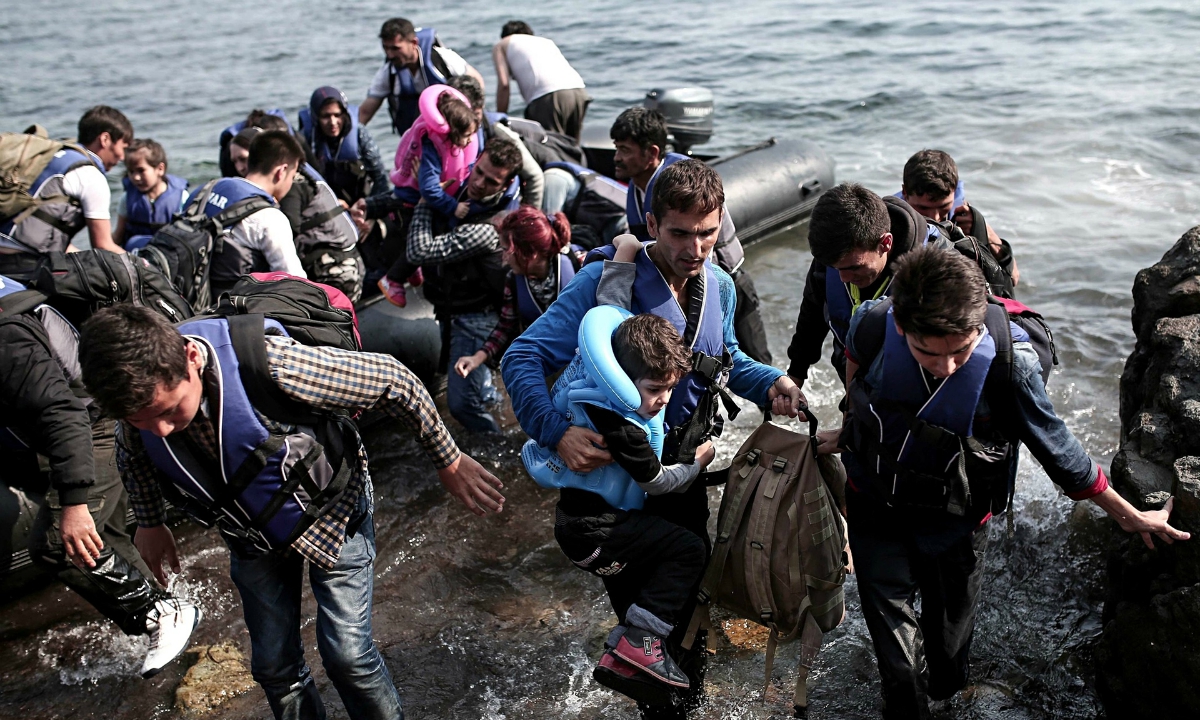
Syrian refugees and the courage to be Christian

Syrian refugees coming ashore at Lesbos.
(Photo: Angelos Tzortzinis/Getty.)
Last week, longtime reader Michael asked me to do a fuller piece on the Syrian refugee crisis. A couple of mass shootings have happened in the meantime, one involving Islamic radicals. Nevertheless, the refugee issue hasn’t been settled; and the Muslim identity of the San Bernadino shooters has thrown more anger and panic into the mix.

The other day, Br. Anthony J. J. Mathison, OP, wrote an excellent essay on the matter, which sums up my thoughts with greater charity and knowledge than I possess. However, it’s too long to quote at length here; and I’m not sure whether Br. Anthony intended it for further publication. So let me confine myself to some general concerns that Br. Anthony and I hold in common. I'm not going to spend the time he did refuting ten common objections, since most of them assume a radical position that brings everyone in without screening or background checks ... a position few if any propose in any seriousness.

The principle of humanity inscribed in the conscience of every person and all peoples includes the obligation to protect civil populations from the effects of war. ...
A particular category of war victim is formed by refugees, forced by combat to flee the places where they habitually live and to seek refuge in foreign countries. The Church is close to them not only with her pastoral presence and material support, but also with her commitment to defend their human dignity: “Concern for refugees must lead us to reaffirm and highlight universally recognized human rights, and to ask that the effective recognition of these rights be guaranteed to refugees”.—Compendium of the Social Doctrine of the Church 505, cit. St. John Paul II, 1990 Message for Lent, 3

“I was a stranger, and you welcomed me ....” This is among six acts that Jesus names in the “Judgment of the Nations” passage (Matthew 25:31-46) as things done by the “sheep”, the righteous, who will “inherit the kingdom prepared ... from the foundation of the world.” In this passage, Jesus draws an unmistakeable “equals” sign between himself and the wretched, even the despised, of the earth, and tells us we may no longer overlook them, that we may no longer neglect them, that we may no longer judge them as lesser beings. Earlier, in the Golden Rule (Matthew 7:12), he told us to treat others as we’d like to be treated; now, we must treat these “least of ... my brothers” as if they were Christ himself!

Saturday, December 5, 2015

“Prayer-shaming” won’t destroy the American pro-gun culture

Cover of 12/3/15 New York Daily News.
As if we needed another political buzzword, we’ve got one now, provided by Atlantic writer Emma Green (and retailed by American Conservative pundit Rod Dreher): prayer-shaming.

A couple of years ago, I came across a meme which suggested that religious people pray instead of doing things to make the world better. Of course, that ignores the vast bulk of history, in which most people who worked for positive social, economic, environmental, and political changes were also people who prayed, went to church, or had some other form of religious expression. (Ever heard of Dorothy Day? Lech Walesa? Blessed Teresa of Calcutta? Martin Luther King, Jr.’s doctorate wasn’t in astrophysics! The list is endless.) In many cases, the activists’ religious convictions pushed them into the fight; in many cases, they considered their devotional lives sources of emotional strength.

The idea that a life of prayer precludes a life of social action is ridiculous on the face of it ... unless you’re a Republican politician. Then you’re fair game for the charge that “the only thing you’re willing to do about this mess is pray!”

There are many assumptions packed into these attacks on prayer [writes Green]: that all religious people, and specifically Christians, are gun supporters, and vice versa. That people who care about gun control can’t be religious, and if they are, they should keep quiet in the aftermath of yet another heart-wrenching act of violence. At one time in American history, liberals and conservatives shared a language of God, but that’s clearly no longer the case; any invocation of faith is taken as implicit advocacy of right-wing political beliefs.

Thursday, November 26, 2015

Catholic Stand: The Politics of American Narcissism

Egotist, n.: A person of low taste, more interested in himself than in me.
—Ambrose Bierce, The Devil’s Dictionary

In 2000, you probably could have asked twenty of your friends and coworkers and found only one person who knew something about narcissism. Fifteen years and a gazillion selfies later, narcissism and narcissist are tools of the trade for the commentariat; activists demand empathy where once they would have been content with sympathy. Often, though, like Bierce’s egotist, it’s a matter of the pot calling the kettle “self-absorbed”.

Narcissism and the Appeal to Pity

Let me give you an example: In 2010, neuroscientists Jennifer N. Gutsell and Michael Inzlicht of the University of Toronto in Scarborough published a paper in the Journal of Experimental Social Psychology. Gutsell and Inzlicht claimed that an experiment showed people displayed differences in “mirror neurons” between viewing people of their own race having difficulty and those of “outgroups” in the same situations. In the latter case, they claimed, to those who had tested high on racial prejudice, the effect of watching “outgroups” in difficulty was similar to “watching a blank TV screen”.

To be fair, Drs. Gutsell and Inzlicht tried to use neutral terms and generalize their conclusions. However, the test subjects were exclusively white. Had they tested non-white subjects in the same manner, I submit they would have found the same correlation, and done better science to boot. They simply hadn’t neutralized the experiment sufficiently. Since they didn’t, the test results were interpreted by the press as a uniquely “white” problem; and outrage generators like Democratic Underground said, “See? They don’t empathize enough with us!”

In informal logic, it’s called an ad misericordiam fallacy, or “appeal to pity”: You must agree with me because 1) I have suffered; 2) I am suffering now; and/or 3) I will (continue to) suffer if you don’t give me what I demand. The narcissist demands that we agree with him, not because he’s right, but because he’s wretched. At its worst, it becomes a manipulative whine: “If you really loved me (if you really empathized with me), you’d do X.”

Read the rest at Catholic Stand!

Happy Thanksgiving!
 

Wednesday, November 18, 2015

Syrian Refugee Crisis: About Those M&Ms ...

There's a couple different versions of a meme going around, featuring a bunch of M&M candies which (supposedly) includes a few poisoned ones. The meme dares you (or your family) to eat them, then compares them to the Syrian refugees.

Well, there's quite a few relevant problems with the comparison, the chief of which is that nothing bad will happen to the M&Ms if nobody eats them. Appellum ad terrorem or ad metum — scare tactics. Beyond that, though, I'm sick of us letting our fear dictate our policies. We've become a nation of entitled scaredy-cats and spoiled brats, afraid to do the right thing because it may hurt, it may cost, it may discommode us, or it may put us out of our comfort zones and puncture our little bubbles of happiness. So here we go:


Tuesday, October 6, 2015

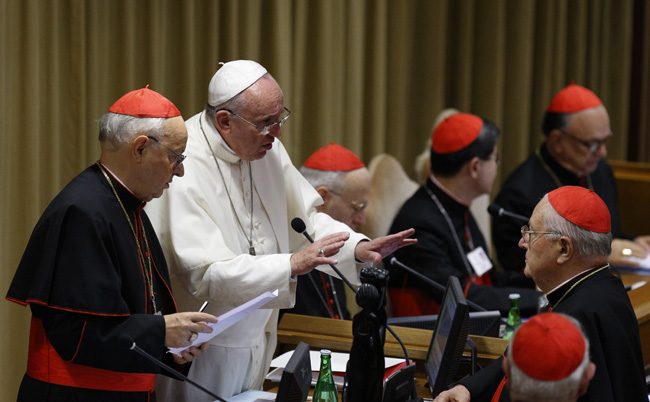
World Synod on the Family 2015: The Magisterium Strikes Back

Pope Francis speaks with Cdl. Angelo Sodano.
(Source: catholicphilly.com.)
The 2015 World Synod on the Family has just opened, and already the conservatives are thumping the progressives 3 – 0.

The first point scored against the progressives was actually an own-goal (or safety, if you prefer American football metaphors). On Friday, Oct. 3, the Congregation for the Doctrine of the Faith fired Msgr. Krzystof Charamsa (aka "Sideshow Chris"), who worked as an assistant secretary for the International Theological Commission, after an interview was released in Corriere della Sera revealing that the prelate is not only gay but in a relationship; he was dismissed because, Fr. Federico Lombardi said, his statement "aims to subject the Synod assembly to undue media pressure."

Why is this an own-goal? Because Sideshow Chris was fired just as a conference of LGBT Catholics was getting ready to convene in Rome to lobby the synod bishops. Before their own opening gavel could drop, they'd already gotten a message from the Vatican: "Sorry, the cafeteria's closed." Moreover, the revelation followed another conference in which celibate gay Catholics came out in support of the Church's sexual teachings. Finally, it was revealed that Sideshow Chris had double-placed "exclusive interviews" with two competing Polish weeklies, Wprost and Newsweek Polska; according to editor Bogusław Chrabota of Rzeczpospolita, "the main intention of Saturday's spectacle was the promotion of a forthcoming book by the priest." Journalists can forgive murder, terrorism, and pedophilia much easier than they can forgive a source who plays them ... at least without their consent.

Notes Artur Rosman (stealing a line from John Médaille), "Charamsa used God, gay rights, and the Polish press to organize a big paycheck for himself. This is how you should stage-manage your 'martyrdom.'" It's not hard to conclude that Sideshow Chris wasted his "fifteen minutes"; if it's not the dumbest activism fail of the year, so far it's certainly the one with the most widespread coverage.

Wednesday, September 30, 2015

Ask Tony: What does the Catholic Church teach about sex changes?

Caitlyn Jenner, the face of transgenderism.
A couple of weeks ago, in Outside the Asylum, I addressed Pope Francis’ recent letter on the Holy Year of Mercy. Today, I received a question there from Charles: “I know a man who recently decided to undergo a sex change procedure. What is the Church’s position on this?”

A Not-So-Obvious Answer

This question comes at a sensitive time for my family and me, as one of my cousins is “transitioning” from a male to a female identity. The answer would seem to be obvious to many people; the best course of action, then, is to research the question to make sure the obvious answer isn’t wrong.

Surprisingly, the answer doesn’t lie in one single Vatican-issued document such as the Catechism of the Catholic Church or a papal encyclical like Deus Caritas Est. According to the Catholic News Service, in 2000 the Congregation for the Doctrine of the Faith did issue a sub secretum letter to the various papal legates, and again in 2002 to the presidents of bishops’ conferences. Strangely enough for a secret document, this letter has remained secret — unlisted with other CDF letters and ad dubitum documents, unmentioned in the USCCB website, and not readily available through Google or Bing. (Apparently Wikileaks hasn’t gotten around to it yet.)

Nevertheless, various Catholic people and sources have addressed the questions of sexual identity and gender reassignment surgery. In lieu of any formal definitive statement, I can attempt an informed provisional answer. And it turns out the answer isn’t as obvious as you may think.

Thursday, September 17, 2015

An atheist defends the intelligence of believers

Image source: bianymeans.com.
It's been said of Roman gladiators that they were required to kill their opponents but not required to hate them. In the best intellectual tradition, people have fought against each other in the arena of the mind while maintaining warm personal relationships with each other in the shelter of society. One particularly good example of this was the long-standing friendship between the skeptical Socialist George Bernard Shaw and the Catholic liberal G. K. Chesterton. A more recent example would be the amity between the great Speaker of the House Thomas P. "Tip" O'Neill and Pres. Ronald Reagan, who exchanged sharp words over policy by day and swapped stories over drinks by night.

I can't call Sincere Kirabo a "friend", but I can certainly give him some warm applause for a post he wrote in his Patheos blog Notes from an Apostate, "Why You Sound Ridiculous Claiming Religiosity is a Mental Defect". "Suggesting people are religious because they are dimwitted or suffer from a fabled religiosity-induced mental illness is a lazy, unthinking way to dismiss behavior one cannot identify with," says Kirabo, who urges his fellow atheists to "cease promoting such embarrassingly ignorant ideas."

I recently had a discussion on social media speaking to the unsound nature of ... arguments that use ableist and denigrating language to describe religious people. Because I adamantly opposed these uncharitable assertions that take an unnecessary and harmful route to delegitimize religiosity, I was branded an “enabler” to faith in the spurious and supernatural. But what does research suggest concerning this matter?
I’ve long been an avid reader of material that meticulously investigates mind perception, religion, and the “how” and “why” of religion. For this reason, I confidently stated that any individual belonging to the knowledgeable intelligentsia would laugh such notions out of the building. This caused me to think on two things: One, I doubt those who disagree will diligently explore facts that contradict their worldview (as the Darwinian Golden Rule suggests we do for the sake of intellectual honesty). Two, why not seek out experts to prove (or disprove) my stance? And so I did.

Thursday, September 3, 2015

Ask Tony: Should I receive Communion only from a priest or deacon?

In the Crux article referenced in the screencap to your left, the author, Rev. Kenneth Doyle, answers the question with a verbal shrug: “It is, of course, the same Eucharist — whether received from a priest or from a lay minister — and ... I am a bit surprised when someone feels compelled to make a choice.” Referring to a deceased parishioner’s aversion to lay Eucharistic ministers, Fr. Doyle said, “In the scope of things, I felt that his preference was a small issue. For me, it came under the heading of the ‘big tent’ that embraces a wide variety of Catholics.”

The person at Saint Gabriel’s Newsroom who wrote the “Share” was, at bare minimum, uncharitable: nothing Fr. Doyle said was in any meaningful sense modernist, nor did he deny or denigrate the right of the consecrated to distribute the Eucharist. Moreover, the boast that s/he only receives on his/her knees and from consecrated ministers is so pompously self-congratulatory it invites ridicule; as we used to say when I was a kid, “Whaddaya want for that, a Bozo button?”

What really is the issue here?

In 1973, with the approval of Ven. Pope Paul VI, the Sacred Congregation for Divine Worship issued the Instruction Immensae Caritatis, which authorized the appointment of “special ministers” from the ranks of the non-ordained to assist with the distribution of Communion. Eventually, to underline the fact that deacons and priests were the ordinary ministers of the Eucharist, the title of these appointees was changed to “Extraordinary Minister of Holy Communion” (usually abbreviated EMHC).