
 |
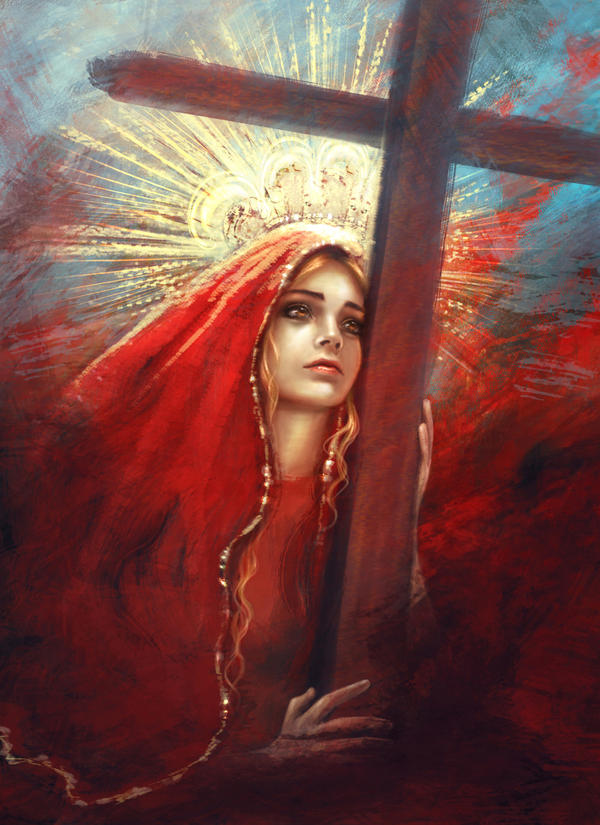
| Blavatskaya, Mary Magdalene. (Image source DeviantArt.net) |
On June 10, the Congregation for Divine Worship released
a document raising the liturgical observance of St. Mary Magdalene’s
traditional day from a memorial to a feast. Released along with it is an
accompanying letter, Apostle
to the Apostles, over the signature of the secretary of the
congregation, Abp. Arthur Roche. Now would be a good time to explain who she is
in the Catholic tradition, and why the Holy See has taken such an extraordinary
step.
Who was Mary Magdalene?
“Mary” (Heb. Miriam,
Aram. Maryam, Gr./L. Maria) was a common name among the
Judeans, and due to the influence of both the Blessed Mother and the Magdalene
would be common in Christian lands for the next twenty centuries. (Maryam is also frequent among Moslems,
among whom the Blessed Virgin Mother is honored.) So in the New Testament there
is a surfeit of women named Mary, not always kept distinct from each other.
There are two locations named “Magdala” in Talmud: one in the east on the River
Yarmouk near the modern town of Umm Qais, the other on the western shore of the
Sea of Galilee, abandoned just prior to the 1948 Arab-Israeli war, near the
town of Migdal. Given the number of Galileans among Jesus’ disciples, Mary most
likely came from the latter.
We know very little about Mary’s story. According to Luke,
Mary joined Jesus’ ministry early. He tells us that “seven demons had gone out
from” her, indirectly attributing it to Jesus, and that she was one of several
women who accompanied Jesus and the apostles, “[providing] for them out of
their means” (Luke
2:1-3) After the Easter narratives, Mary of Magdala drops out of the scriptural
record.
Tradition occasionally identifies Mary as the “sinful woman”
in Luke
7:36-50 who anointed Christ’s feet and wiped his hair. John identifies this
woman — without speculating on her sinfulness — as the sister of Martha and
Lazarus (John
12:1-8; cf. John
11:2), who sat at Jesus’ feet with the male disciples (Luke 10:38-42).
However, John clearly identifies Lazarus’ family as living
in Bethany, just east of Jerusalem (John
11:1). The parallel passages in Matthew and Mark indicate that the episode
took place “at Bethany in the house of Simon the leper,” without naming the
woman; the Lucan episode may have taken place in Nain. In Matthew, Mark, and John,
Judas Iscariot complains about the use of the money; in Luke, the Pharisee
expresses interior doubts about Jesus, whereupon Jesus instructs that “her
sins, which are many, are forgiven, for she loved much; but he who is forgiven
little, loves little” (Luke
7:47).
The “sinful woman” of Nain is most likely not Mary of
Bethany; Mary of Bethany is definitely not Mary of Magdala. Nevertheless, from
just after the Reformation until after Vatican II, the Church revered Mary
Magdalene as the ideal penitent, whose love for God was greater than her sins.
Saint Gregory of Tours, in his De miraculis (“Concerning Miracles”), records that the Magdalene
retired to Ephesus. However, a French tradition has her traveling with Lazarus,
Maximinus (an otherwise unknown member of the seventy disciples), and others to
Marseille, where she helped to spread the faith through Provence, and spent the
last years of her life fasting and performing penitential rites. (Another
tradition shipwrecks the party on Malta, like St. Paul.) Two locations claim to
have her relics: the Abbey of La Madeleine in Vézelay, Burgundy, and
Saint-Maximin-la-Sainte-Baume in Provence.
The Apostle to the Apostles
In Matthew, Mary Magdalene is returning from the empty tomb
accompanied by “the other Mary”, the mother of James and Joseph (cf. Matthew
27:56,61); they had seen an angel who had informed them of Christ’s
resurrection. Jesus meets them along the way; after they worship him, he reinforces
the angel’s instruction to the apostles to go to Galilee, where he will meet
them (Matthew
28:1-10).
Mark tells us that Jesus appeared first to Mary Magdalene
alone, who told the apostles as they mourned. However, they dismissed her
report (Mark
16:9-11). Luke only reports the appearance of the angel to the Magdalene,
who was accompanied by Mary, the mother of James, and Salome; again, the
apostles dismiss the report (Luke
24:1-11). Saint Paul records an appearance to St. Peter (Cephas) prior to
the apostles that isn’t recorded in the Gospels, but doesn’t mention the
Magdalene.
In John, Mary Magdalene goes to the tomb alone; it is empty,
but no angel and no guards are present. She informs the apostles, and
apparently follows Peter and John back to the tomb; after they leave, she
stands outside of it weeping. When she looks in, she sees two angels, who ask
her why she weeps. Then Jesus approaches her from behind; once she recognizes
him (“Rabboni!”), he instructs her to
tell the apostles that he is ascending to the Father. (John
20:1-2,11-18).
In other words, the exact role the Magdalene played in the
Easter story is somewhat confused. Nevertheless, she is the only woman
identified in all four Gospels as having gone to Jesus’ tomb on Easter morning, and three of the traditions record that she was the first
follower to see and speak with the Risen Christ. Because she announced the
Resurrection to the Eleven, by the twelfth century scholars commonly called her
“the apostle to the apostles”. Writes Abp. Roche:
What is certain is that Mary Magdalene was part of the group of Jesus’ disciples, she accompanied him to the foot of the Cross and, in the garden where she met him at the tomb, was the first “witness of Divine Mercy” (Gregory the Great). The Gospel of John tells us that Mary Magdalene wept because she could not find the body of the Lord (John 20:11); and that Jesus had mercy on her by letting himself be known as her Master, thus transforming her tears into paschal joy. (Apostle to the Apostles, para. 3)
What is the difference between a memorial
and a feast?
Liturgies are ranked according to their importance within
the liturgical year. At the top of the list are the liturgies involved in the
Paschal Triduum of the Passion and Resurrection of the Lord (Good Friday, Holy
Saturday, Easter Sunday). At the bottom are weekdays in Ordinary Time, when no
other observance is listed in the general or proper calendar. Special
observances, for the most part, are ranked in descending order: Solemnities,
Feasts, and Memorials. Solemnities trump Sundays in Christmas or Ordinary Time;
only feasts pertaining directly to Jesus trump Sundays, while memorials never do.
The rules are complex, and somewhat subject to the
discretion of the local bishop or pastor; see
this .pdf to be thoroughly confused. The reason for the order of precedence
is that holy days with fixed dates don’t have fixed days of the week; some
dates aren’t fixed according to the Gregorian calendar but rather by a
calculation based on the Jewish lunar calendar.
In my post on the
parts of the Mass, I noted that certain prayers vary with the liturgical
seasons or with special dates in the life of the Church. These prayers are
known as propers. And there is one
prayer, the Gloria, which is said or
not said according to the calendar. As a general rule, the higher the
precedence, the more parts of the Mass are changed according to the event or
person being celebrated.
In the Memorial of St. Mary Magdalene, according to the 2011
English Missal, there are no readings assigned, nor will there be for the
Feast. However, there is an Entrance Antiphon (John 20:17), a Collect (the
prayer said prior to the Scripture readings), a Prayer over the Offerings (said
prior to the beginning of the Eucharistic prayers), a Communion Antiphon (2
Corinthians 5:14-15), and a Prayer after Communion. Of the five Propers, only
the Communion Antiphon doesn’t mention her; however, it is appropriate.
As a Feast, falling on July 22, the celebration of St. Mary
Magdalene ranks with feasts of the Blessed Virgin and the other apostles, and
takes precedence over all memorials. (According
to Elise Harris of CNA, there are 15 other memorials listed on July 22.) The Gloria, ordinarily not said on a weekday or in a memorial, will be said or sung. It
also has a special Preface, a particular Eucharistic prayer, assigned to it,
which was issued with the decree and letter; Fr. Thomas Rosica of the Vatican
Press Office provided a
working translation for Zenit. If July 22 fell on a Sunday, it would be
observed on Monday, July 23, which would ordinarily be the Optional Memorial of
St. Bridget. And, as it falls in midsummer, it would be impossible for any moveable
feast or solemnity of the Lord to disturb it.
So What’s the Point?
Here’s the point, says the decree, issued over the signature
of prefect Cdl. Robert Sarah:
Given that in our time the Church is called to reflect in a more profound way on the dignity of Woman, on the New Evangelisation and on the greatness of the Mystery of Divine Mercy, it seemed right that the example of Saint Mary Magdalene might also fittingly be proposed to the faithful. In fact this woman, known as the one who loved Christ and who was greatly loved by Christ, and was called a “witness of Divine Mercy” by Saint Gregory the Great and an “apostle of the apostles” by Saint Thomas Aquinas, can now rightly be taken by the faithful as a model of women’s role in the Church.
Every episode in the life of the Lord wherein Jesus
interacts with women is fraught with compassion and understanding. That the
Risen Christ chose to manifest himself first to a woman who was not one of the
Twelve is itself an intensely meaningful fact. So St. Thomas Aquinas found it:
Late runs woman for pardon, who had run early to sin; in paradise she had taken up unbelief, from the sepulchre she hastes to take up faith; she now hastens to snatch life from death, who had before snatched death from life. ... [In] mystery and not by accident, the two came under one name. She came, but altered; a woman, changed in life, not in name; in virtue, not in sex. The women go before the Apostles, bearing to the Lord’s sepulchre a type of the Churches; the two Marys, to wit.
For Mary is the name of Christ’s mother; and one name is twice repeated for two women, because herein is figured the Church coming out of the two nations, the Gentiles and the Jews, and being yet one. Mary came to the sepulchre, as to the womb of the resurrection, that Christ might be the second time born out of the sepulchre of faith, who after the flesh had been born of her womb; and that as a virgin had borne Him into this life present, so a sealed sepulchre might bring Him forth into life eternal. It is proof of Deity to have left a womb virgin after birth, and no less to have come forth in the body from a closed sepulchre. (The Golden Chain 1:2:28)
Mary of Magdala has been misunderstood for centuries. But
then, so have women. And while there have been many women who have a greater
impact on the intellectual life of the Church, the image of Mary falling at the
feet of Jesus resurrected comes at the heart, which has a logic of its own. It
may be late, but I’m glad to see St. Mary Magdalene restored to her place among
those who were closest to Jesus during his earthly ministry, and her place in
the imaginative and liturgical life of the Church.
Short Answer: Mary Magdalene is special because she was “the apostle to the apostles,” the first
to be visited by the Risen Christ and to announce the good news to others.

